Confused by the IELTS 9‑band scale? You’re not alone. The system is precise, transparent, and once you understand the raw‑score‑to‑band conversion, you can target your preparation more effectively.
Below we break down exactly how your answers turn into that final report. We’ll cover Listening, Reading, Writing, and Speaking, with practical raw‑score tables and free calculators to give you instant estimates.
Understanding the IELTS Band Score System
IELTS reports a band score from 0 to 9 for each skill (Listening, Reading, Writing, Speaking) and an overall band—the average of the four, rounded to the nearest half or whole band. Every correct answer in Listening and Reading gives you one raw mark (out of 40). Writing and Speaking are assessed by trained examiners using detailed descriptor bands.
Why Raw Score Conversion Matters
The raw marks you get in the Listening and Reading modules are not your final band score. Instead, IELTS uses a conversion table that turns your raw total into a 0–9 band. This conversion differs slightly between Academic and General Training Reading because the passages differ in difficulty and text type.
Knowing your raw‑to‑band target helps you:
- Set realistic goals for each practice test
- Identify how many correct answers you need for your desired band
- Track progress without waiting for official results
For an instant estimate, use our IELTS Raw Score Calculator—it does the conversion for you in seconds.
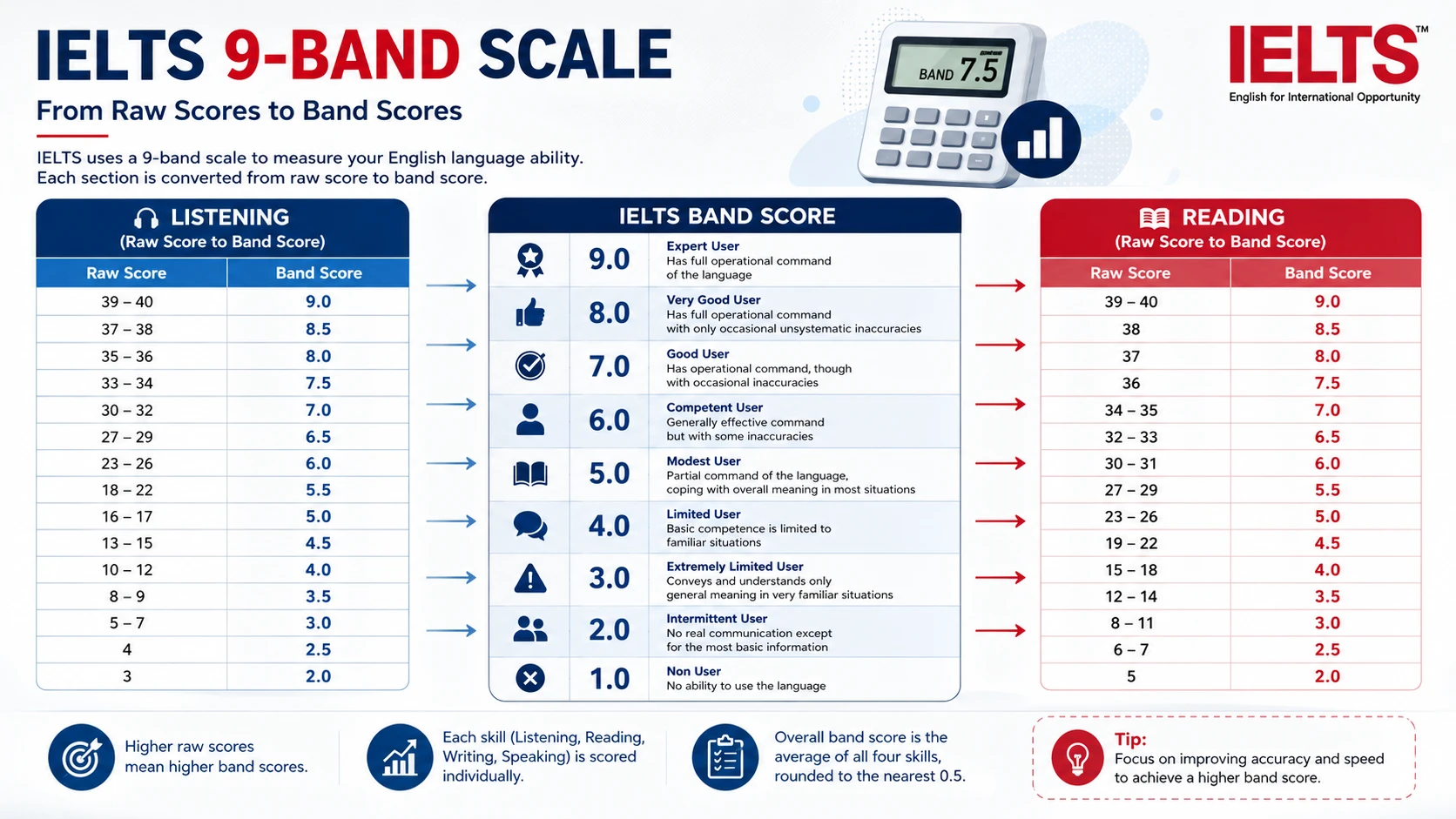
IELTS Raw Score Conversion: Listening and Reading
Listening (always 40 questions)
| Raw Score (out of 40) | Approx. Band Score |
|---|---|
| 39–40 | 9 |
| 37–38 | 8.5 |
| 35–36 | 8 |
| 32–34 | 7.5 |
| 30–31 | 7 |
| 26–29 | 6.5 |
| 23–25 | 6 |
| 18–22 | 5.5 |
| 16–17 | 5 |
| 13–15 | 4.5 |
| 10–12 | 4 |
Note: These bands can vary slightly by test version, but the table is a reliable guide.
Academic Reading (40 questions)
| Raw Score | Approx. Band Score |
|---|---|
| 39–40 | 9 |
| 37–38 | 8.5 |
| 35–36 | 8 |
| 33–34 | 7.5 |
| 30–32 | 7 |
| 27–29 | 6.5 |
| 23–26 | 6 |
| 19–22 | 5.5 |
| 15–18 | 5 |
| 13–14 | 4.5 |
| 10–12 | 4 |
General Training Reading
The conversion for General Training is more generous at the lower bands but tighter at the top. Typically, you need 40 out of 40 for a band 9, 39 for 8.5, 38 for 8, etc. Use the IELTS Raw Score Calculator to toggle between Academic and General Training modes.
How Writing and Speaking Are Assessed
Unlike Listening and Reading, Writing and Speaking don’t have a raw‑score count. Instead, examiners award bands based on four key criteria:
Writing Task 1 & Task 2
- Task Achievement / Task Response
- Coherence & Cohesion
- Lexical Resource (vocabulary)
- Grammatical Range & Accuracy
Speaking
- Fluency & Coherence
- Lexical Resource
- Grammatical Range & Accuracy
- Pronunciation
Each criterion is weighted equally. Your speaking exam is recorded, and writing is evaluated by at least two examiners to ensure fairness and reliability—hallmarks of the expertise, authoritativeness, and trustworthiness (E‑E‑A‑T) that define IELTS.
Calculating Your Overall Band Score
Your overall band is the average of the four individual skill scores, rounded to the nearest half or whole band. For example:
- Listening 7.5, Reading 6.5, Writing 6.0, Speaking 7.0
- Average = (7.5 + 6.5 + 6.0 + 7.0) ÷ 4 = 27.0 ÷ 4 = 6.75
- Rounded up to 7.0 (the next half band)
If the average ends in .25, it goes up to the next half band (e.g., 6.25 → 6.5). If it ends in .75, it goes up to the next whole band (e.g., 6.75 → 7.0).
Want a quick way to see your overall band? Try our IELTS Overall Band Score Calculator—just enter your four scores and it does the rounding instantly.
Why Trust This Information?
All data comes from official IELTS publications, experienced teachers, and continuous analysis of past tests. The raw‑score tables are consistent with those used by major test centres. Our calculators are designed to mirror the official conversion logic, giving you a trustworthy estimate while you prepare.
Remember, your best strategy is to combine realistic practice with a solid understanding of scoring. Bookmark these tools, use them alongside official materials, and you’ll walk into the test with confidence—and clarity about exactly what you need to score.